

How to Know If Your AC Needs Repair or Replacement
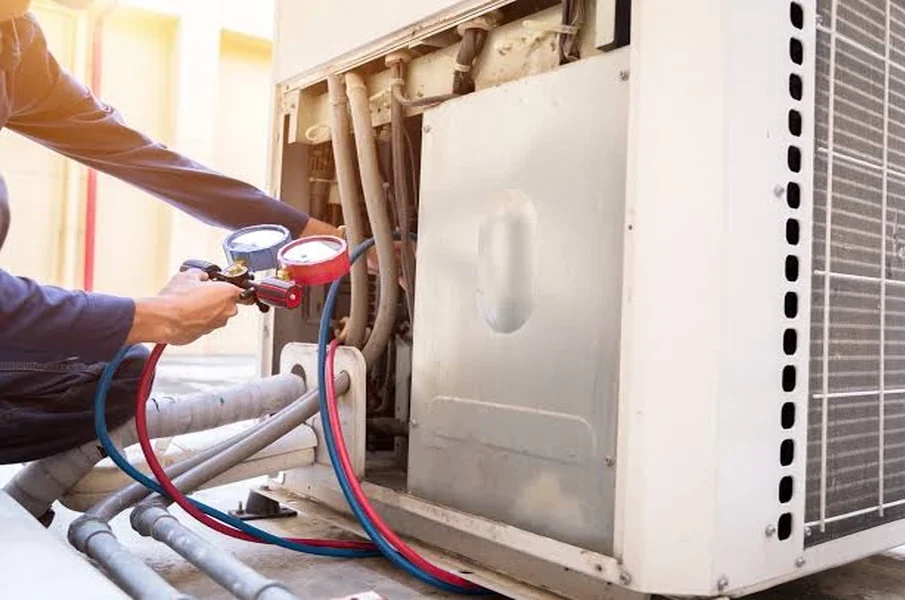
Your AC stops cooling on a Saturday in July. The technician gives you two numbers: a repair estimate and a replacement estimate. You have about 90 seconds to decide which way to go. Most homeowners freeze. They either spend money fixing a machine that’s going to fail again in 18 months, or they replace a unit that had years of good cooling left in it.
Neither outcome is great. The good news is that this decision is far less mysterious than it feels in that moment. There are four signals that tell you almost everything you need to know, and you can evaluate all of them before you ever pick up the phone.
Why the Repair-or-Replace Question Matters More Than Ever
Air conditioning is not a luxury appliance. According to the U.S. Energy Information Administration’s 2020 Residential Energy Consumption Survey, 88% of U.S. households use air conditioning, with the Midwest and South regions reaching usage rates of 92% and 93% respectively. In those climates, a failed AC is not an inconvenience you can postpone; it is a problem you solve immediately, often under pressure.
That pressure is exactly what leads to bad decisions. Vendors know you’re uncomfortable, and urgency rarely produces good negotiating conditions. Building a clear picture of your system’s health before a breakdown puts you in control. Think of this guide as that picture.
The Four Signals That Drive the Decision
1. Age
Age is the most honest variable in the whole equation. A system under 10 years old that has been regularly maintained almost never warrants full replacement after a single isolated failure. A system over 15 years old is in a fundamentally different conversation.
The reason is cumulative wear. A compressor that gives out on a 6-year-old unit is a parts problem. The same compressor failure on a 16-year-old unit usually signals that the whole system is approaching its end. Capacitors, contactors, coils, and motors all degrade on roughly parallel timelines. Fix one major component late in the system’s life and you are likely buying one more summer, not five.
That said, age alone never closes the argument. A 15-year-old unit that runs perfectly, keeps the house at the set temperature, and draws the same power it always has is worth maintaining. Age only becomes decisive when it combines with one of the signals below.
2. Repair Cost Relative to Replacement Cost
The “5,000 Rule” is the most useful back-of-the-envelope tool in this space. Multiply your system’s age (in years) by the quoted repair cost in dollars. If that product exceeds $5,000, replacement is almost always the financially sounder choice. If it falls well below $5,000, repair wins.
A concrete example makes this easier to use. Suppose your system is 12 years old and the technician quotes $350 to replace a failed capacitor. 12 x 350 = $4,200. Repair. Now suppose the quote is $800 for a refrigerant leak repair. 12 x 800 = $9,600. Replacement deserves serious consideration. The rule is not gospel, but it gives you a number to push back on when a salesperson presents a replacement as the only option.
3. Energy Bill Trends
This one is easy to overlook because utility bills creep upward slowly. But the U.S. Energy Information Administration reports that, on average, more than half of a household’s annual energy consumption, specifically 52% in 2020, goes to space heating and air conditioning alone. That means an inefficient AC system is not a minor cost center; it is your single largest household energy expense, and a degrading unit will widen your bill every season.
Pull up last summer’s electric bills and compare them to the same months two and three years ago. Adjust for any rate increases from your utility. If your consumption has risen by more than 15% with no obvious change in usage habits, your system is working harder to deliver the same output. That extra effort is a symptom, not a normal aging pattern.
4. Comfort and Consistency
A functioning AC should keep every room within two or three degrees of your thermostat setting. Hot spots, rooms that never cool down, and humidity that sits heavy in the air all point to a system that can’t distribute or condition air properly anymore.
Here’s the important nuance: inconsistency can be a duct problem, a thermostat problem, or a refrigerant problem, not necessarily a failing unit. Before you conclude that the whole system is shot, get a technician to run a proper diagnostic. Dirty evaporator coils, for example, are a surprisingly common culprit that a cleaning can resolve for a fraction of the cost of replacement.
The STAR Framework: A Quick Self-Check Before You Call
Before scheduling a service visit, run through these four checkpoints. This is the STAR diagnostic check, and it takes less than five minutes.
S – System age: Is your unit over 12 years old? If yes, replacement enters the conversation at any repair quote above $500.
T – Trends in your bills: Are your summer electric bills climbing without explanation? Note the percentage increase and share it with your technician.
A – Active repair history: Have you had more than one service call in the last 18 months? Frequent minor repairs are a pattern, not bad luck.
R – Room-by-room comfort: Are there consistent hot spots or humidity problems that persist even when the system is running? Log the rooms and the conditions.
Bring this information to your service call. A technician who sees you’ve done this homework will give you a more precise diagnosis, and you’ll be far better positioned to evaluate whatever they recommend.
When Repair Is the Clear Winner
Repair makes obvious sense when the system is under 10 years old, the failure is an isolated, replaceable component like a capacitor or a contactor, the 5,000 Rule produces a number below $5,000, and energy bills have held steady. In that scenario, you’re probably looking at a routine mechanical failure, not a system in decline.
A quick filter change and a refrigerant top-up on a young, well-maintained system almost never needs a second opinion. Just get it fixed and schedule a maintenance visit for the following season.
When Replacement Makes More Sense
| Scenario | System Age | 5,000 Rule Result | Recommendation |
|---|---|---|---|
| Minor part failure, first repair ever | Under 10 years | Under $5,000 | Repair |
| Second repair this season | 10 to 14 years | Under $5,000 | Repair with caution; plan for replacement |
| Compressor failure | Over 12 years | Over $5,000 | Replace |
| R-22 refrigerant system, any major failure | Any | Any | Replace (R-22 is phased out and costs are prohibitive) |
| Rising bills plus repeated failures | Over 15 years | Over $5,000 | Replace immediately |
The R-22 row deserves special emphasis. If your system still runs on R-22 refrigerant, the economics of repair have already broken down. That refrigerant is phased out, which makes sourcing it expensive and increasingly difficult. Any significant repair on an R-22 system should trigger a replacement conversation regardless of age.
Getting Professional Eyes on the Problem
Self-diagnostics are valuable, but they have a ceiling. Some failure modes, such as coil fouling, refrigerant migration, or blower motor degradation, don’t produce obvious symptoms until they’ve already cost you real money in wasted energy. A qualified technician with the right instruments will catch those problems before they snowball.
When your system shows any of the warning signs above, connecting with a proven local provider matters. Homeowners in the St. Louis area, for instance, often call on air conditioning services that offer both repair and full system installation so a single company can give an honest assessment without a financial stake in pushing one option over the other.
That objectivity is worth paying for. An inspection that costs you $100 and saves you from an unnecessary $6,000 replacement is one of the best returns you’ll get on a home services call all year.
The Timing Question Nobody Thinks About Until It’s Too Late
Spring is the best time to schedule a diagnostic, full stop. Every HVAC company in a warm climate gets buried in June and July when units start failing mid-heat wave. Scheduling in March or April means faster appointments, calmer technicians, and no pressure to decide something expensive on the spot because your house is 84 degrees and you have guests coming in two days.
If your system is already showing warning signs, don’t wait. The difference between a planned replacement in April and an emergency replacement in August can be measured in both dollars and stress. Start the conversation now, get the data, and make the call on your schedule, not your AC’s.