
Whole Home Surge Protection: What New Hampshire Homeowners Should Know Before Storm Season
Four hundred and eighty dollars. That is what my neighbor Dave paid last spring to replace the control board in his heat pump after a Thursday afternoon thunderstorm rolled across the Merrimack Valley and knocked his power out for exactly nine seconds. Dave had a power strip under his desk. He did not have a surge protector on the panel. Nine seconds of outage cost him more than a whole house unit would have.
That story is the entire argument for whole home surge protection in one paragraph, and it is why I keep bringing it up at cookouts. I am not an electrician. I am a homeowner in southern New Hampshire who has watched this state’s storms get weirder every summer, and who got tired of learning about surge physics the expensive way. So I called people who do this for a living, including the surge protection electricians in New Hampshire at Al Terry Plumbing and Heating, and asked the questions every homeowner should ask before writing a check.
Here is what I found out, in the order it matters to your wallet.
What actually kills your electronics
Everyone pictures a lightning bolt hitting the roof. That’s the cinematic version. The boring version is far more common: when the grid drops and comes back, or when a tree branch grazes a line three streets over and the utility recloses the breaker, voltage spikes ride your wiring into every outlet in the house. Your fridge, your furnace board, your router, your washer’s control panel. All of it is downstream.
Your power strip handles a fraction of that. A standard strip clamps the voltage at the outlet and absorbs a limited amount of energy before it gives up. A whole home unit mounts at the panel and intercepts the spike before it ever reaches the branch circuits. Different job, different scale.
I will say the quiet part out loud: if you own a heat pump, an EV charger, or anything with a circuit board in it, and you don’t have panel-level protection, you’re gambling. The odds are mostly in your favor every single day, right up until the day they aren’t.
How surge protectors are actually rated
Two numbers matter on the box. The first is clamping voltage, the level at which the device starts diverting excess voltage away from your wiring. Lower is better, and anything north of roughly 400 volts isn’t doing much for sensitive electronics. The second is surge current capacity, measured in kiloamps, which tells you how much energy the unit can absorb before it fails. This is the number cheap units quietly hide.
The safety benchmarks behind those ratings do not come from marketing departments. They come from UL Solutions, the standards organization that tests and certifies electrical products sold in the United States. If a device you’re considering doesn’t carry a UL listing, that’s your answer right there. Skip it and stop reading reviews.
| What you’re protecting | Power strip enough? | Whole home unit needed? |
|---|---|---|
| Phone, laptop, monitor | Yes | Not for these alone |
| Router, modem, smart TV | Partially | Yes, these die quietly |
| Furnace or boiler control board | No | Yes |
| Heat pump or central A/C | No | Yes |
| EV charger and garage outlets | No | Yes |
Why New Hampshire homes get hit harder than you’d think
We live in a state with real weather. Thunderstorms, ice storms, nor’easters, and the occasional derecho that knocks out half the grid. The National Weather Service tracks and reports on severe weather across the region, and anyone who’s lived here through a few winters knows the pattern: the outage is rarely the problem. The restoration is.
Here’s the piece most homeowners miss. When a utility re-energizes a line after an outage, that restoration is not gentle. It can arrive as a hard reclose, and whatever is plugged in on the other end eats it. Multiply that by every outage in a season and you start to understand why surge damage shows up as a slow accumulation rather than one dramatic event. Your microwave didn’t die from lightning. It died from the eleventh flicker of the year.
Older housing stock makes this worse. A lot of New Hampshire homes run on panels that were sized for the 1970s and have since absorbed a heat pump, a mini-split, an EV charger, and a finished basement. Crowded panels and tired grounding are not surge protection problems, exactly. They’re surge vulnerability problems, and they’re worth having someone look at while the cover is already off.
Installation: what the day actually looks like
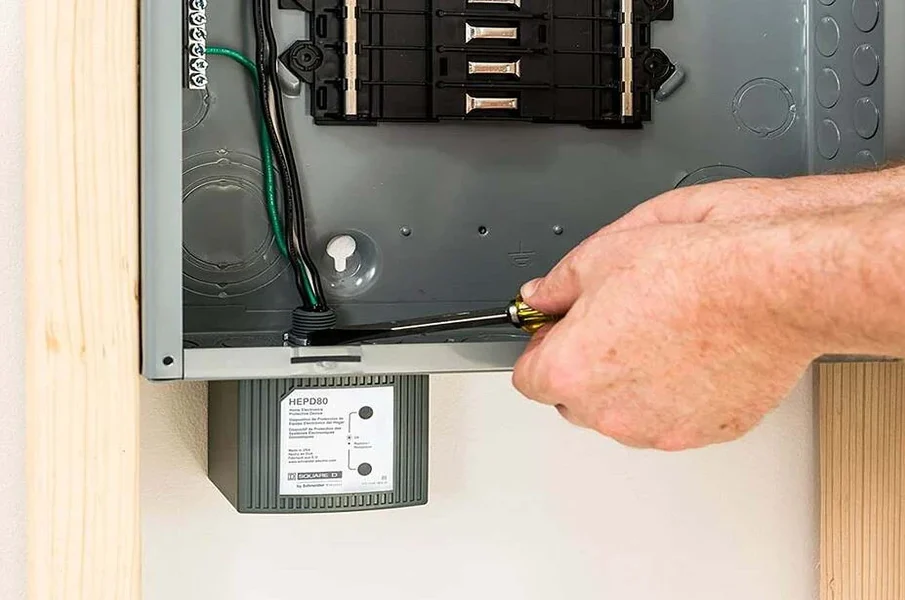
Here’s the part I wish someone had told me before I spent a Saturday reading forum threads. Panel-level surge protection is not a weekend project, and it isn’t a “buy the box online and wing it” job either. It involves opening the panel, working near the main lugs, and terminating conductors in a specific order so the unit’s leads stay as short as possible. Long, looping leads reduce how well the device performs. That is not opinion, it’s physics.
A few things to sort out before anyone touches your panel:
- Confirm your panel has space and capacity. Some older panels need a tandem breaker or a subpanel before a surge device can go in at all.
- Ask about the grounding electrode system. A surge protector needs somewhere to send the energy. Weak grounding means the energy goes somewhere you didn’t intend.
- Decide on coverage scope. Whole home unit only, or whole home plus point-of-use strips at the expensive stuff? I’d do both, and I’d put a strip behind the TV and at the garage freezer.
- Ask what happens after a big event. Quality units have an indicator light that tells you the module sacrificed itself. If the installer can’t explain that, keep calling.
- Get the warranty in writing. Manufacturer warranty on the device and workmanship warranty on the install are two different documents. You want both.
Budget-wise, this sits in the same range as a mid-tier appliance repair, and considerably below the cost of replacing a heat pump board. If you’re already having electrical work done, adding it to the ticket is close to a no-brainer.
What I’d actually do
The federal government’s Department of Energy publishes homeowner guidance on protecting electronics and managing home energy use, and the recurring theme is defense in depth. One device does not cover a whole house of sensitive equipment. Layering matters.
So here’s my stance, and you can take it or leave it. If your home has a heat pump, a boiler with a control board, or an EV charger, put a whole home unit on the panel. Then put point-of-use strips at the three most expensive things you own. Then write the install date on the panel cover with a Sharpie so future you remembers when it went in.
And if you’re in the middle of a remodel anyway, or your panel is already open for another reason, just do it then. The incremental cost is small and the alternative is a Tuesday afternoon where the furnace won’t fire and the parts store is closed.
Questions worth asking your electrician
Ask what Joule rating and clamping voltage the unit they’re proposing carries. Ask whether it’s UL listed. Ask how short the leads will be and whether the panel has room. Ask what the indicator light looks like and where it sits. A good electrician will answer all four without reaching for a brochure.
Dave asks me about this every spring now. He replaced the board, added the whole home unit, and spent the rest of that summer complaining about the cost of the first repair instead of the second. That’s a fair trade. The storm doesn’t care whether you were planning to get around to it.
So, when’s the last time you opened your panel and actually looked at what’s protecting the stuff plugged into it?